
How I Went From Cramming to Actually Retaining Everything I Studied
- Lux Seminare
- Jul 4
- 5 min read

I used to think I was bad at remembering things.
Every exam cycle looked the same. Two weeks out I'd tell myself this time would be different. I'd open my notes, read through everything carefully, highlight the important parts, maybe rewrite a summary or two.
Then I'd walk into the exam and watch half of it evaporate.
Not because I hadn't studied. I had. I just hadn't retained anything. For a long time I didn't understand the difference.
This is what changed.

What Cramming Actually Does to Memory
For most of secondary school I thought studying meant going through material until it felt familiar. Familiar felt like knowing. It wasn't.
Familiarity is recognition. It is when your brain says "I've seen this before." Retention is recall. It is when your brain is being able to produce information without a prompt. They feel identical when you're reading your own notes. They feel completely different when you're staring at an exam question with no hints.
Cramming builds familiarity fast. It builds almost no recall. And familiarity without recall is useless in an exam room.
The other problem with cramming is timing. Even when it works, when you genuinely manage to hold the material in your head through sheer repetition, it only holds for about 72 hours. After that, without reinforcement, it decays. Every semester I was essentially starting from zero on material I'd technically already learned the semester before.
I wasn't building knowledge. I was renting it.
The First Thing that Actually Worked
The first real shift happened when I stopped reading my notes and started testing myself on them instead.
It felt counterproductive at first. Close the notes, try to write down everything I remembered about a topic, then check what I missed. The gaps were embarrassing. I clearly knew less than I thought I did.
But within a week of doing this consistently, something clicked. The material that I'd struggled to recall on day one was coming back faster. The gaps were getting smaller. I wasn't just recognizing the information when I saw it, I could actually produce it from nothing. This is active recall. It works because the act of retrieval is what builds the memory trace, not the act of reading. Every time you successfully pull something from memory, the neural pathway gets stronger. Every time you read something passively, it doesn't.

The Second Thing: Reviewing at the Right Time
Active recall fixed the quality of my studying. But I still had a timing problem.
I'd test myself on something, remember it well, and then not look at it again for three weeks. By then it had faded enough that I was almost relearning it. The effort of that first recall session was partially wasted because I hadn't reinforced it at the right moment.
The right moment is just before you'd forget it.
This is the logic behind spaced repetition. Reviewing material at increasing intervals that match how memory actually works. The first review happens soon after learning, while the trace is still fresh but starting to fade. The next review happens a few days later. Then a week. Then two weeks. Each successful recall extends the interval because the memory is getting stronger. The forgetting curve (the rate at which memory decays) gets flatter with each well-timed review. Material that once needed cramming every few weeks starts only needing a quick review every month or two. Eventually it becomes something you just know.
How I Stopped Managing this Manually
The problem with running spaced repetition yourself is the scheduling. You have to remember when you last reviewed something, what you rated it, and when it's due again. Across every topic, every subject, every week. I tried doing this with a spreadsheet for about two weeks before abandoning it.
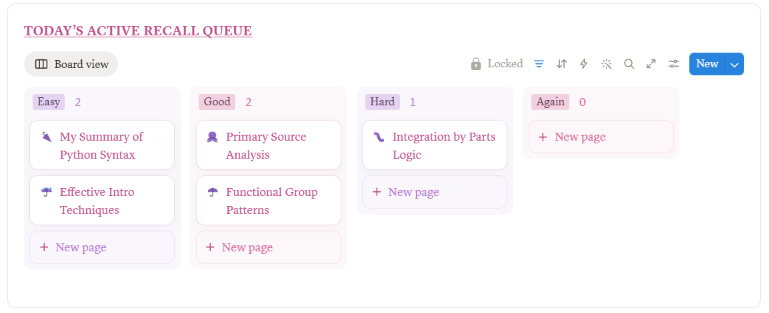
What actually worked was building it into Notion. A simple database where I log what I studied, rate how well I recalled it (Easy, Good, or Hard), and a formula calculates the next review date automatically. Easy gets reviewed in seven days. Good in three days. Hard in one day.
I open it every morning and see exactly what's due for review. No decisions, no tracking, no spreadsheet. Five minutes to clear the queue, then I study new material.
The result: After about six weeks of using this consistently, I stopped blanking on exam questions. Not because the exam got easier. Because the material was actually in my long-term memory instead of just sitting in short-term storage waiting to decay.
What the Process Looks Like Now
A typical study session now has three parts:
Review first. Open the Learning Tracker, clear whatever is due today. Usually five to fifteen minutes depending on how many items are queued. This takes priority over new learning every single time.
Study new material actively. Read a section, close it, write what I remember. Check the gaps. Add anything new to the tracker with today's date and a starting rating.
One-sentence summary per concept. Before closing the session, I write one sentence per new concept in my own words and not copied from the source. If I can't write the sentence, I don't understand it well enough yet.
That's the whole system. No color coding, no elaborate dashboards, no five-step morning routine. Just review, active recall, and logging.
The Difference It Made
Before this system, exam preparation meant two weeks of panic and a 72-hour memory that evaporated after the paper.
After this system, material I'd studied months earlier was still retrievable. I stopped re-learning things I'd technically already covered. Exam preparation shifted from desperate coverage to confident review of things I actually knew.
The change wasn't studying harder. It was studying in a way that matched how memory actually works instead of how it feels like it should work.
If you're currently cramming and wondering why it never quite sticks, this is why. And the fix is more accessible than it might seem.
What's Coming in August
The Learning Tracker is the memory and recall layer of something larger I'm building, the Student OS.
It takes this same spaced repetition system and connects it to everything else in your student life: your courses and deadlines, your GPA tracking, your career and internship pipeline, your finances. One workspace, six systems, everything linked.
If you want early access before it opens publicly, the Learning Tracker gets you on the list automatically.
Summary
Cramming builds familiarity, not recall, and they feel identical until the exam
Active recall (testing yourself without notes) is what actually builds retrievable memory
Spaced repetition times reviews to happen just before forgetting, extending the retention window with each successful recall
Managing spaced repetition manually is unsustainable. Building it into a system removes the scheduling overhead entirely
The free Learning Tracker automates the review queue so the only decision is showing up



Comments